What Is Fabric Protocol (ROBO): How the Robotics Token Powers an Onchain Machine Economy
What is Fabric Protocol (ROBO)? Grounded in the vision of transforming robotics into open public infrastructure, Fabric Protocol (ROBO) seamlessly connects decentralized coordination with innovation in the robotics and automation industry. By utilizing blockchain technology, it anchors robot identity, participation, and network incentives onchain while integrating advanced robotics into the evolving digital economy.
With the backing of a foundation-led ecosystem model and growing exchange visibility, Fabric Protocol (ROBO) is shaping the evolution of robotics-linked digital assets while creating structured access points for builders, contributors, and token holders to participate. Beyond a financial asset, it actively supports network fees, bonded participation, and governance signaling, ensuring its continued relevance within an incentive-driven robotics network.
This article aims to shed light on Fabric Protocol (ROBO), revealing its purpose, defining features, and market potential. If you’re looking to explore its practical uses, assess its investment potential, or stay updated on blockchain-powered infrastructure trends, this guide delivers key takeaways.
Key Takeaways
- Fabric Protocol is an open robotics network concept aiming to coordinate robot identity + contributions using onchain primitives.
- Launched on Base (EVM), Fabric plans to evolve into its own Layer-1, aiming to power a robotics-native blockchain ecosystem.
- $ROBO is designed for network fees, participation bonds (stake-to-contribute), and governance signaling (ve-style)
A Deep Dive into Fabric Protocol: What Is $ROBO?
Fabric Protocol (ROBO) is a utility token powering a robotics-focused onchain network that is currently operating on Base (EVM), with a roadmap that targets expansion into a dedicated Layer-1 (L1) as the ecosystem matures. The project embodies the following values:
- Open robotics infrastructure (robot networks should be composable, not closed)
- Verifiable contribution (participation tied to measurable, verified work)
- Community-driven evolution (tools, skills, and coordination improve over time)
Fabric Protocol (ROBO) not only inherits the spirit of open, community-driven innovation but also applies it to the robotics infrastructure sector to build a sustainable, transparent, and collaborative global network.

Source: Fabric Protocol on X
Fabric Protocol Goes Trending After $ROBO Listings and Airdrop Buzz
In late February 2026, Fabric Protocol moved from a niche robotics narrative into broader crypto spotlight. The team opened its airdrop eligibility + wallet binding window, requiring users to register wallets before any future claim phase. Within days, major centralized exchanges announced $ROBO spot listings, accelerating liquidity access and price discovery.
Public market trackers showed market capitalization fluctuating around the $80M+ range during early trading sessions, while daily trading volumes quickly expanded into the multi-million-dollar range, signaling strong speculative participation.
The convergence of three catalysts—time-bound airdrop mechanics, exchange liquidity events, and a robotics × onchain infrastructure narrative—pushed ROBO into trending dashboards!
Fabric Protocol (ROBO) Price Prediction for 2026: What to Expect?
Factors such as market conditions, project fundamentals, and community trust shape cryptocurrency valuations. With its current market capitalization around the mid–eight-figure range and active spot trading volume in the multi-million-dollar range, Fabric Protocol (ROBO) is anticipated to remain in the $0.03 – $0.06 price range under stable market conditions. If adoption in the robotics × blockchain infrastructure sector accelerates, its value may rise toward the $0.08 level during strong bullish cycles.
Key Drivers of Fabric Protocol (ROBO) Price Movement
Several factors shape the potential value of Fabric Protocol (ROBO):
- Market Dynamics: Overall crypto sentiment, liquidity inflows, and exchange trading volume significantly influence short-term price swings.
- Adoption & Practical Use Cases: Increased onchain participation and ecosystem activity can support sustained token demand.
- Technological Development & Expansion: Ongoing development within the robotics-focused blockchain framework may strengthen long-term investor confidence.
Future Growth Prospects
If Fabric Protocol (ROBO) maintains its growth within the robotics and decentralized infrastructure industry, rising demand could push its valuation higher. Experts suggest that continuous development and increasing adoption may elevate its price toward the $0.08 zone, though investors should remain cautious of market volatility and regulatory changes.
Source: coinmarketcap.com
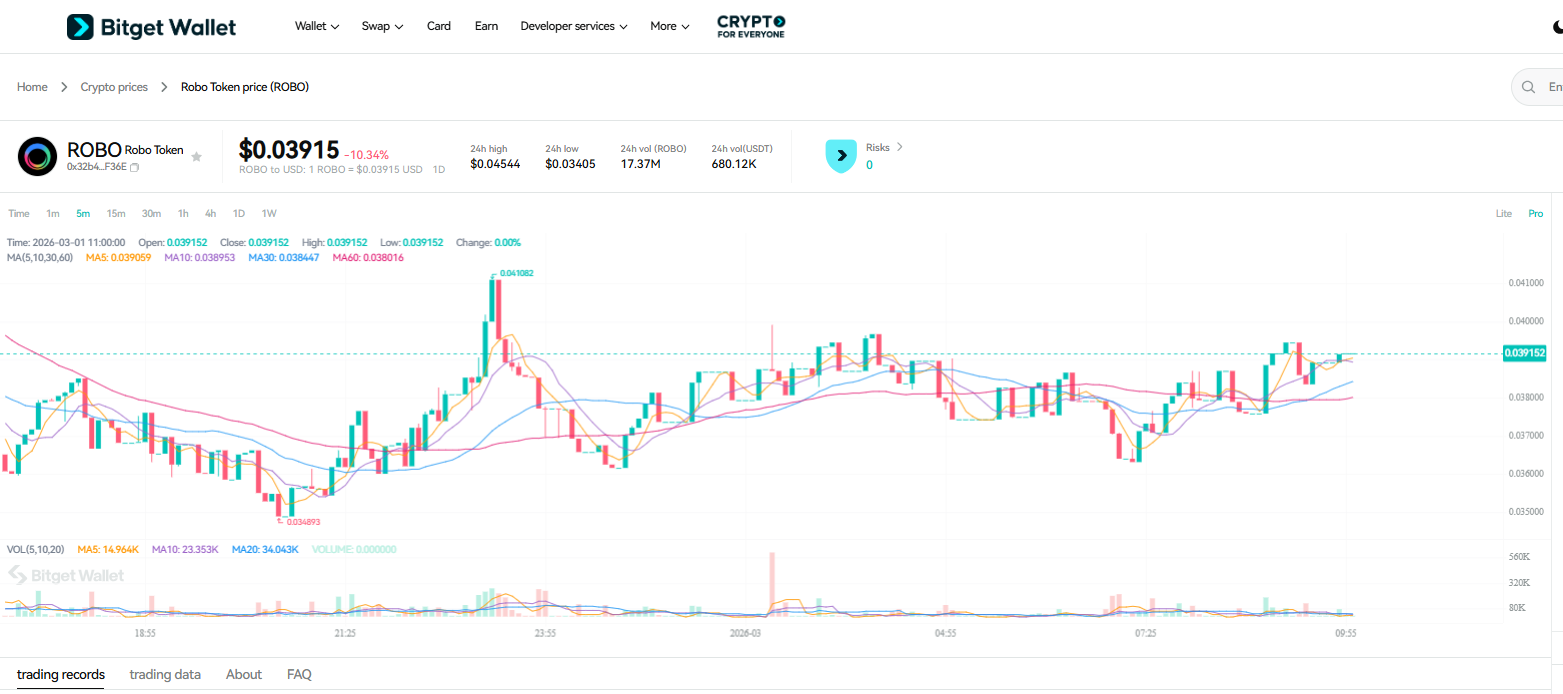
Source: Bitget Wallet
Fabric Protocol (ROBO) Key Innovations: Top Reasons to Watch
The standout features of Fabric Protocol (ROBO) include:
-
Onchain Identity for Robots
Fabric’s narrative centers on robots operating with wallet-linked identity, enabling a consistent way to authenticate interactions, record participation, and track permissioned actions without relying on a single centralized operator.
-
Stake-to-Contribute Participation Bonds
Instead of “stake ROBO and earn,” Fabric emphasizes a bonded participation model—where $ROBO can be used to signal commitment, unlock access, or align incentives with verifiable contributions. This matters because it positions ROBO as a network resource rather than a pure speculative chip.
-
Governance Signaling via Locked Voting Power (ve-style)
Fabric describes governance signaling mechanisms that can be structured like vote-escrow (ve) models—where longer lockups can translate into stronger governance influence. This is typically used to align long-term participants with protocol decisions.
Understanding Fabric Protocol (ROBO): The Technology Behind It
Fabric Protocol is a decentralized coordination concept designed to empower users and builders through onchain settlement, identity primitives, and token-based participation mechanisms. Rather than focusing on DeFi yield, Fabric’s “tech story” is about coordination and verification—who did what, when, and under what rules.
Below is a step-by-step overview of how the Fabric ecosystem is framed to work:
| Step | Process | Benefit |
| 1. Blockchain Integration | Fabric launches with an EVM-compatible base layer (often described as Base) for decentralized settlement. | Faster adoption via EVM tooling + composability |
| 2. Token Transactions | Users use $ROBO for network fees (identity, verification, participation actions). | Clear utility demand if usage grows |
| 3. Smart Contracts | Protocol contracts can enforce rules for bonding, verification, and parameter updates. | Transparent rules + reduced “trust me” assumptions |
| 4. Governance Participation | Long-term holders can lock ROBO (ve-style) to signal/vote on network parameters. | Aligns decision-making with committed participants |
| 5. Incentive Routing | Network revenue can be structured to create buy-pressure mechanics (e.g., fee conversion) and rewards tied to verified actions. | Utility loop that scales with real usage |
Who Leads Fabric Protocol (ROBO) - Team & Key Partnerships
The Team
Fabric Protocol is stewarded by the Fabric Foundation, a non-profit entity responsible for ecosystem governance, long-term protocol development, and economic coordination. Rather than operating as a traditional single-company startup, Fabric follows a foundation + contributor model, designed to support decentralized growth and community participation.
The core technology and early architecture were developed by OpenMind, a robotics-focused company building open infrastructure for intelligent machines. OpenMind continues to serve as a primary technical contributor, helping drive protocol design, robotics integration, and onchain coordination mechanisms.
This structure positions Fabric as an ecosystem-led initiative, where development is guided by foundation oversight and technical contributors rather than centralized corporate control.
Key Partnerships
Fabric’s ecosystem strength is reinforced through:
- OpenMind collaboration, providing robotics expertise and technical infrastructure.
- Institutional backing via OpenMind’s funding round led by Pantera Capital, with participation from major crypto-native investors.
- Major exchange listings, enhancing liquidity and global distribution.
- Base (EVM) ecosystem integration, ensuring compatibility with Ethereum tooling and scalable smart contracts.
Together, these elements create a foundation-supported, capital-backed, and infrastructure-aligned ecosystem for ROBO’s long-term development.
The Role of Fabric Protocol (ROBO) in Robotics Infrastructure: Use Cases Explained
1. Key Use Cases of Fabric Protocol (ROBO)
Fabric Protocol (ROBO) serves a variety of purposes, including:
-
Network Fees & Settlement
Paying for protocol-level actions like identity, verification, and coordination events.
-
Participation Bonds (Stake-to-Contribute)
Using ROBO to bond participation, align incentives, and discourage low-quality or malicious activity.
-
Governance Signaling (veROBO-style)
Locking ROBO to participate in parameter decisions—useful in networks that need to tune incentives, verification rules, or resource allocation.
-
Builder Access & Ecosystem Entry
Enabling builder onboarding mechanics (e.g., stake requirements or permission signaling) for those who want to launch modules, skills, or apps around the ecosystem.
These applications highlight the practical value of $ROBO in a robotics-centric network model—where “use” is tied to network coordination, not just trading.
2. How Fabric Protocol (ROBO) Is Transforming Robotics Infrastructure?
Fabric’s core bet is that robotics can scale like software only if coordination becomes open, modular, and verifiable. By anchoring identity, participation, and incentives onchain, Fabric tries to shift robotics from:
- Closed systems → composable networks
- opaque contribution → verifiable participation
- single-owner roadmaps → ecosystem-driven evolution
If Fabric succeeds in attracting builders and proving real usage beyond hype cycles, ROBO’s value proposition becomes less about “memetic momentum” and more about network demand.
Fabric Protocol (ROBO) Roadmap Explained: What’s Coming Next?
The roadmap for Fabric Protocol (ROBO) outlines a clear path for growth and innovation:
| Quarter | Roadmap |
| Q1 2026 | Launch initial Fabric infrastructure on Base (EVM), activate robot identity modules, and enable early task settlement mechanisms. |
| Q2 2026 | Introduce contribution-based incentives tied to verified robotic tasks and data submission, expand developer onboarding and ecosystem participation. |
| Q3 2026 | Scale multi-robot coordination workflows, improve data validation pipelines, and enhance bonded participation mechanics for contributors. |
| Q4 2026 | Optimize governance signaling (ve-style mechanisms), refine economic parameters, and prepare technical groundwork for Layer-1 expansion. |
| Beyond 2026 | Transition toward a dedicated Fabric Layer-1, purpose-built for machine-native settlement, robotic identity, and autonomous coordination at scale. |
These milestones highlight the practical value of $ROBO in the robotics and decentralized infrastructure sector.
How to Buy Fabric Protocol (ROBO) on Bitget Wallet?
Buying Fabric Protocol (ROBO) on Bitget Wallet is easy! Just follow these simple steps:
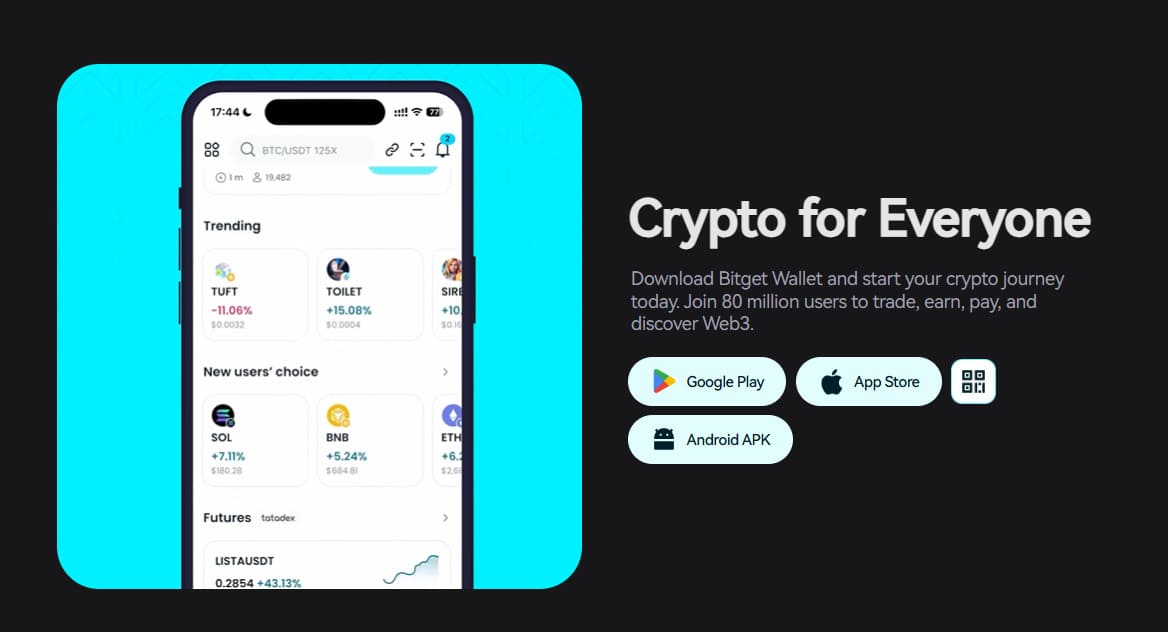
Step 1: Create a wallet
- If you don't have a wallet, download Bitget Wallet app now.
- Register with your phone number or email, verify quickly and you can use it right away.
Step 2: Deposit money into your wallet
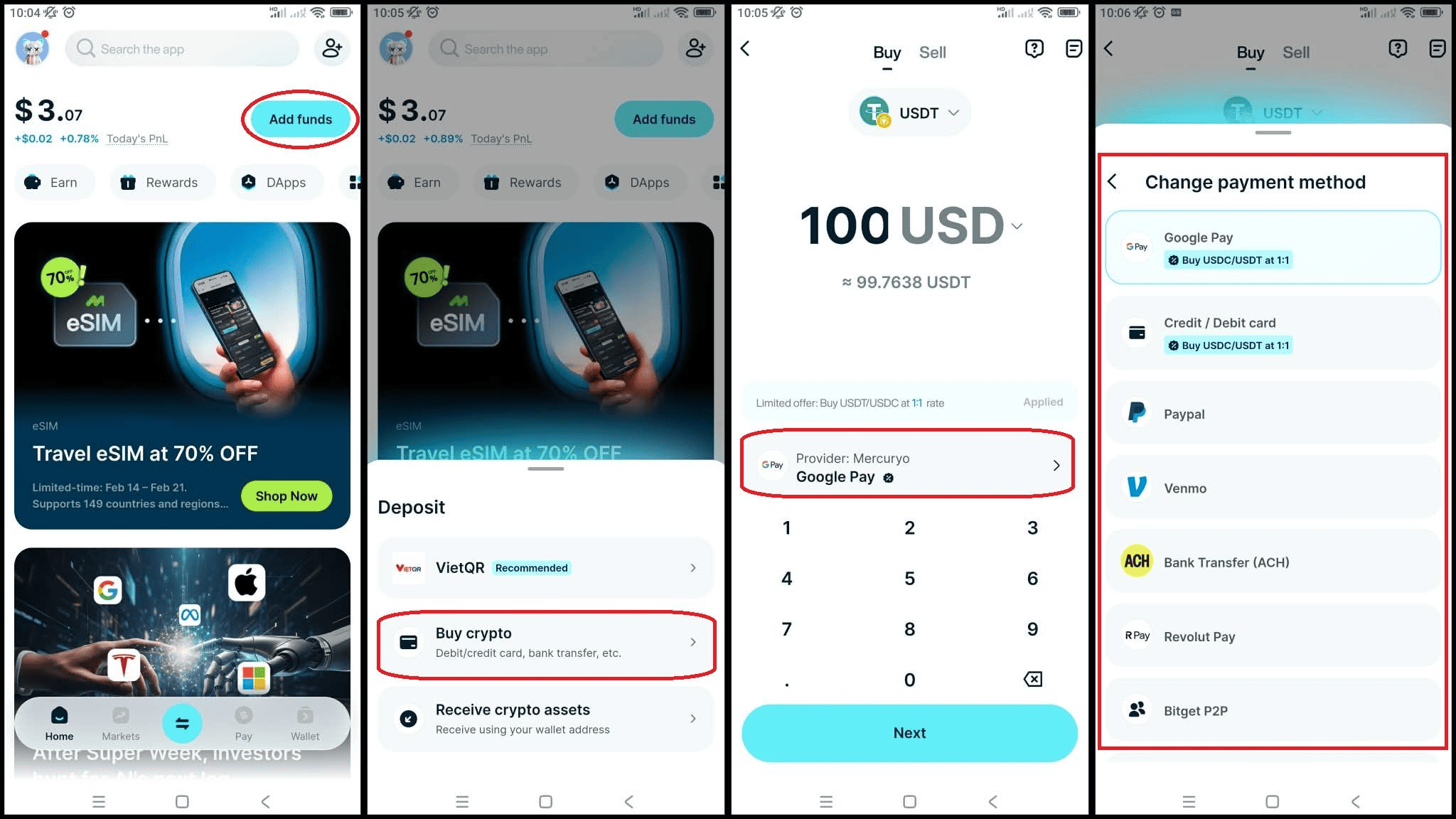
Once you have finished your wallet, you just need to deposit money into it. You can:
- Transfer coins from other wallets: Send BTC, ETH or any coin you have from an external wallet.
- Buy directly with a card: Use a bank card or credit card to buy USDT or ETH right in the app and then exchange it for USDC.
Step 3: Find Fabric Protocol (ROBO)
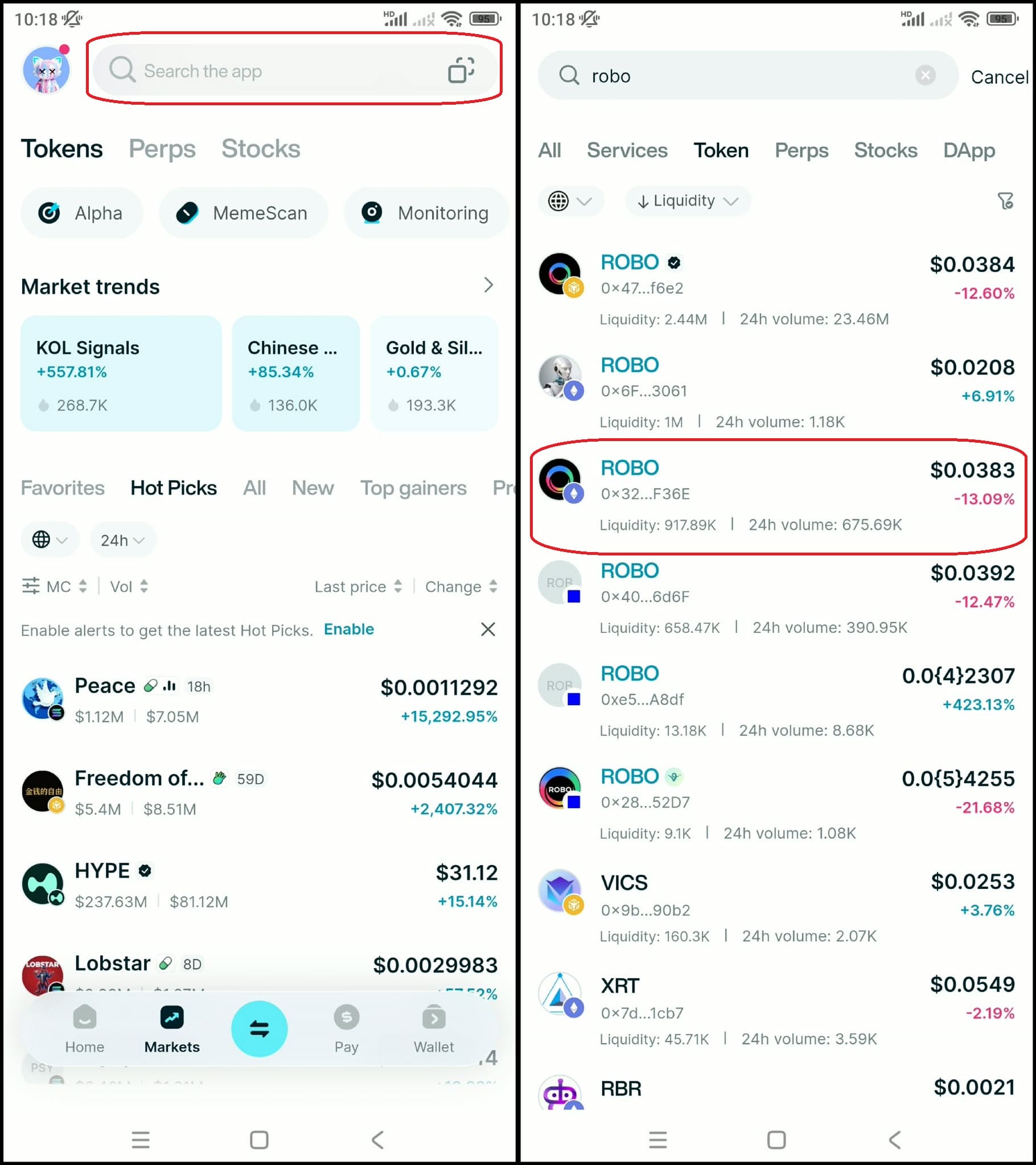
- In the main interface of the wallet, go to Market, type "ROBO" in the search bar.
- Select Fabric Protocol (ROBO) to see the trading page.
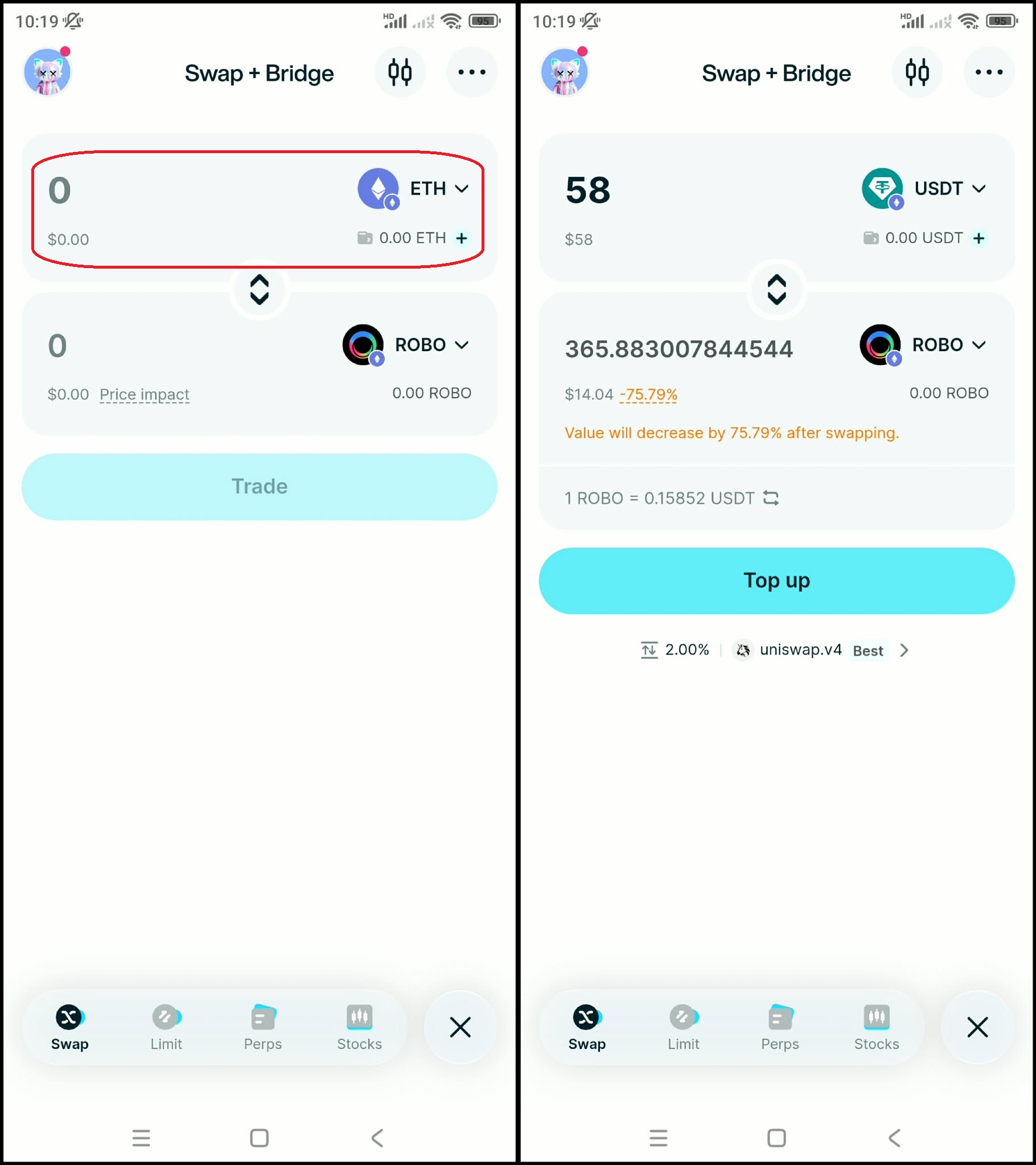
Step 4: Select the trading pair
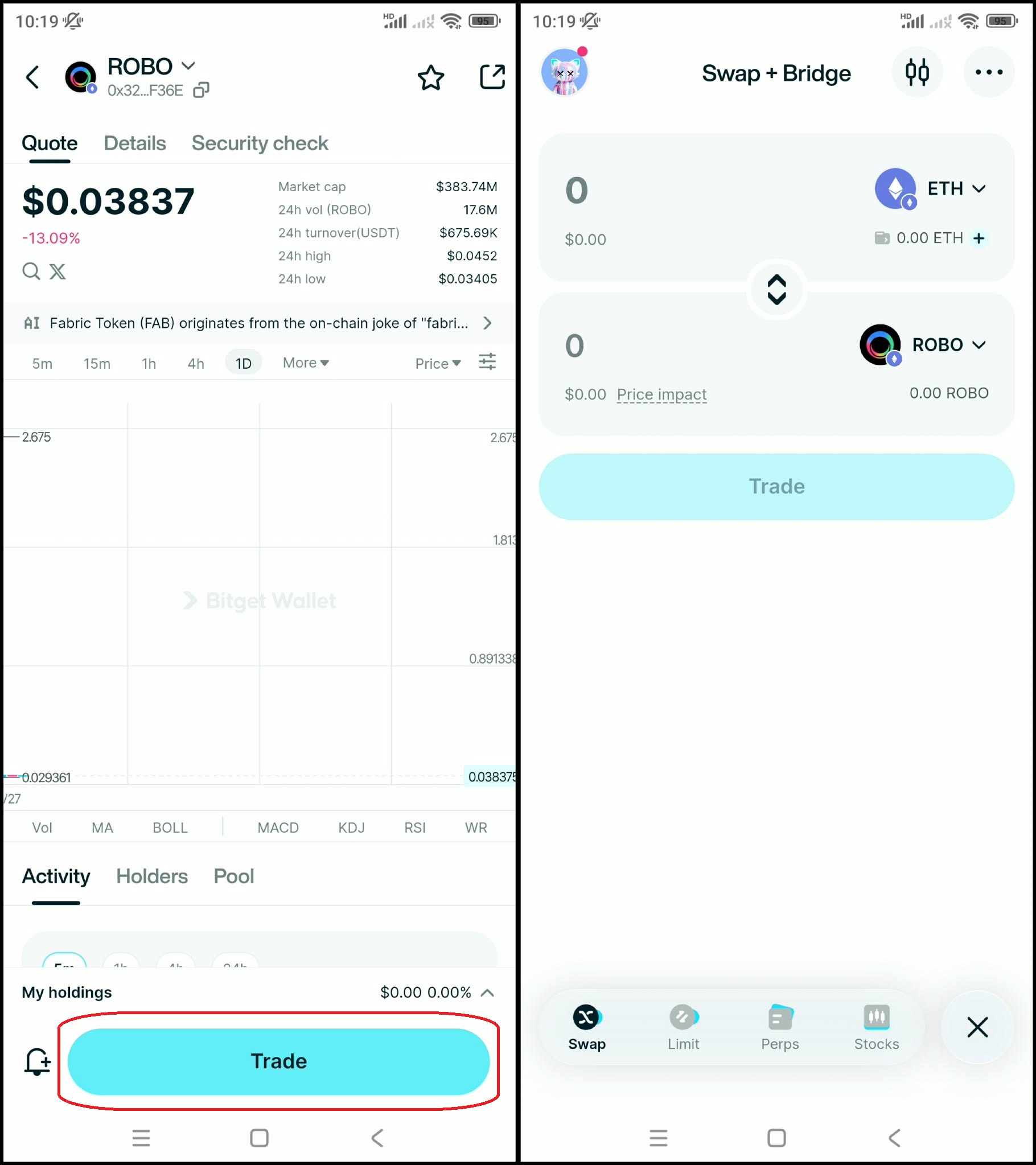
Select the pair you want to trade, for example ROBO/USDT. So you can use USDT to buy Fabric Protocol (ROBO), or vice versa.
Step 5: Place an order
Enter the amount of Fabric Protocol (ROBO) you want to buy, check carefully and confirm the order.
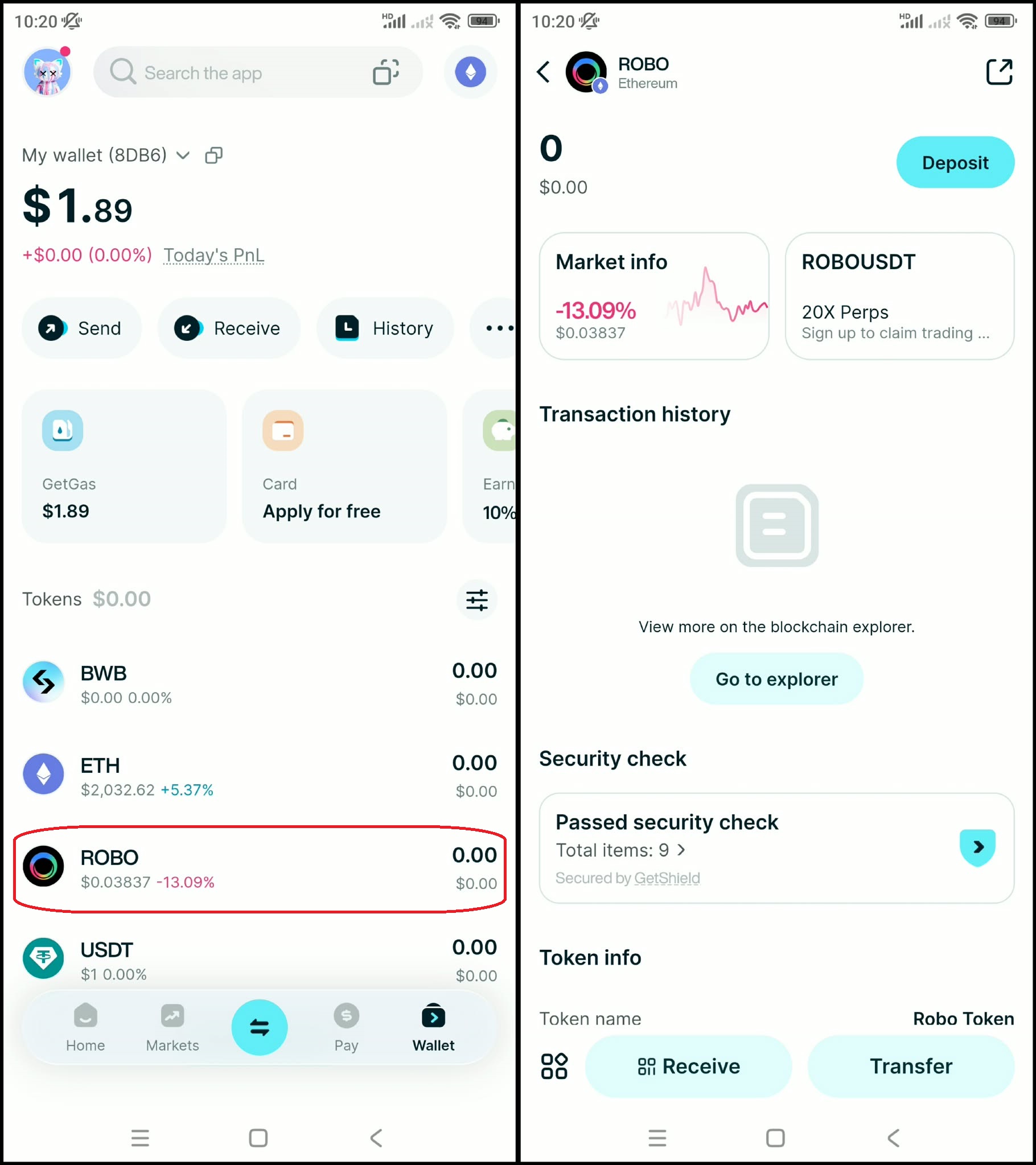
Step 6: Check the order
After buying, you can check your ROBO in the Wallet section.
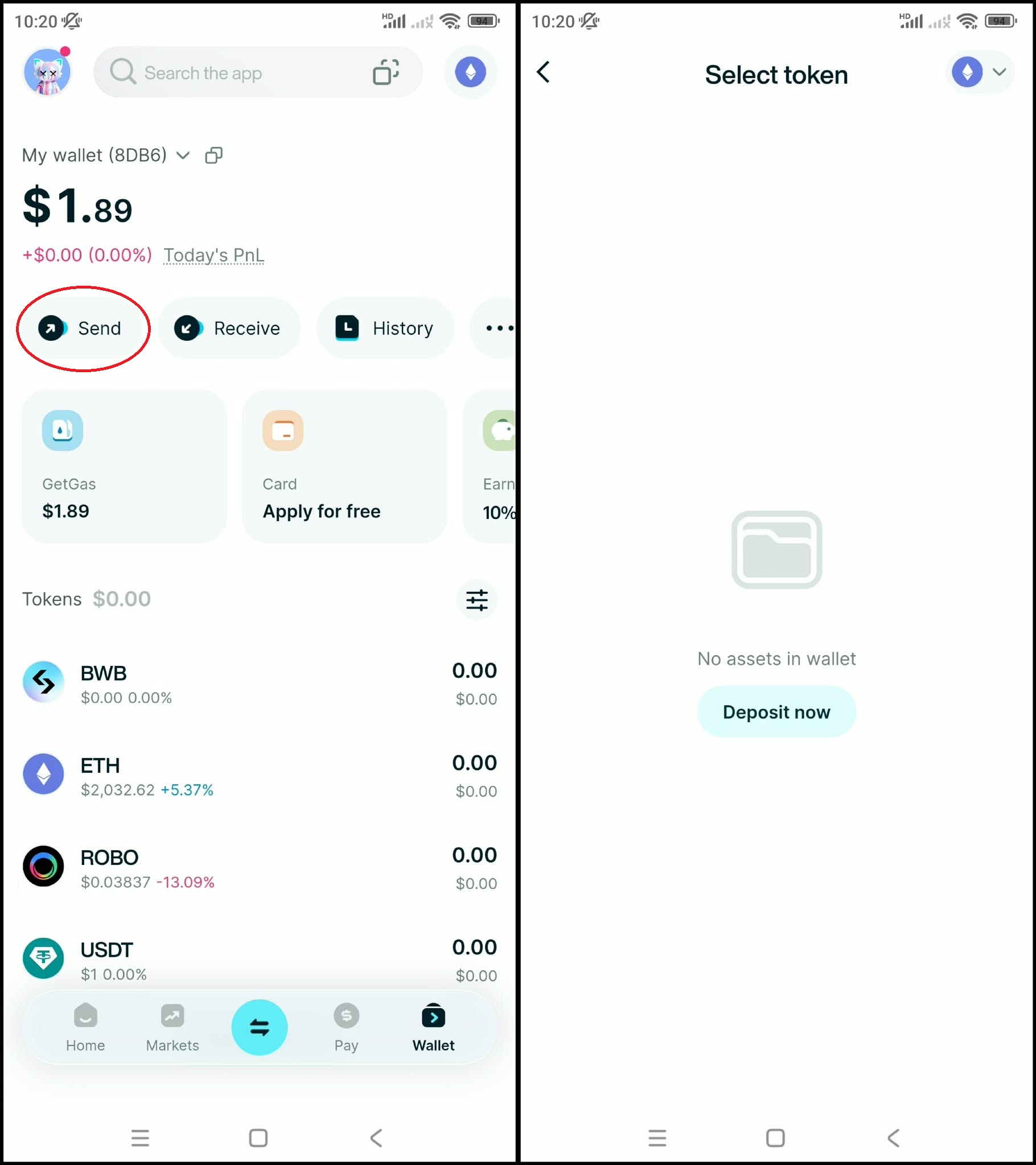
Step 7: Withdraw (if needed)
Once you have Fabric Protocol (ROBO), if you want to withdraw to another wallet, go to Withdraw, fill in the receiving wallet address, check the blockchain network and the amount carefully, then confirm.
▶Learn more about Fabric Protocol (ROBO):
- What is Fabric Protocol (ROBO)?
- Fabric Protocol (ROBO) Airdrop Guide
- Fabric Protocol (ROBO) Listing Date and How to Buy It
Related Reading on USDT & USDC Yield
If you're exploring USDT earn or USDC earn opportunities — from fixed APY savings to on-chain yield strategies — these guides will help you understand how stablecoin yield works, how to evaluate risk, and how to optimize returns safely.
🔹 Understanding Stablecoin Yield Basics
- Yield Farming: What Is It and How Does It Work?
- How to Earn Passive Income With Cryptocurrency? A Beginner’s Guide
🔹 USDT Earn & Yield
- USDT Earn Explained: How to Generate Yield on Tether Safely
- How to Earn Yield on USDT: Fixed vs Flexible APY Compared
🔹 USDC Earn & Yield
- USDC Earn Explained: A Complete Guide to Yield, APY, and Risk
- USDC Earn Returns: How to Evaluate APY, Liquidity, and Smart Contract Exposure
- Stablecoin Earn Plus: What USDC Earn Is and How to Start Generating Yield
🔹 Evaluating APY & Risk
- What Is APY in Crypto and How Yield Is Calculated
- Stablecoin Yield Risks: Smart Contracts, Counterparty & Liquidity
Conclusion
Fabric Protocol (ROBO) is gaining attention because it’s trying to tokenize something real: robot coordination infrastructure. Instead of chasing DeFi yield, Fabric focuses on core primitives like settlement, identity, bonding, and governance signaling—foundational layers that could unlock a robotics ecosystem similar to an “app store for skills” if the roadmap executes as intended.
If you want to approach ROBO in a more disciplined way, Bitget Wallet is a sensible all-in-one choice: self-custody control, convenient swap/bridge functionality, and built-in execution safeguards (contract and approval risk prompts) that help you avoid common mistakes when ROBO is trending. Using Bitget Wallet makes you “better” in practice because you can enter positions quickly with control, verify the correct contract, and manage your assets under a true self-custody standard instead of relying on third parties.
Download Bitget Wallet now to explore Fabric Protocol (ROBO) and be part of the onchain robot infrastructure revolution!
Sign up Bitget Wallet now - grab your $2 bonus!
FAQs
1. What is Fabric Protocol (ROBO)?
Fabric Protocol is a robotics-focused onchain network concept that anchors robot identity, participation, and incentives on public ledgers. ROBO is the utility token used for network fees, participation bonds, and governance signaling.
2. How does Fabric Protocol work?
Fabric frames an ecosystem where robots and contributors use onchain identity + smart contracts to coordinate actions, verify participation, and route incentives. Fees and participation actions can require ROBO, while long-term participants can lock ROBO for governance signaling (ve-style).
3. What is the best ROBO Wallet?
Bitget Wallet is a strong choice for ROBO because it’s self-custodial, supports fast swaps via the verified contract page, and provides security tooling (approval checks, contract risk prompts) for safer onchain trading.
Risk Disclosure
Please be aware that cryptocurrency trading involves high market risk. Bitget Wallet is not responsible for any trading losses incurred. Always perform your own research and trade responsibly.